
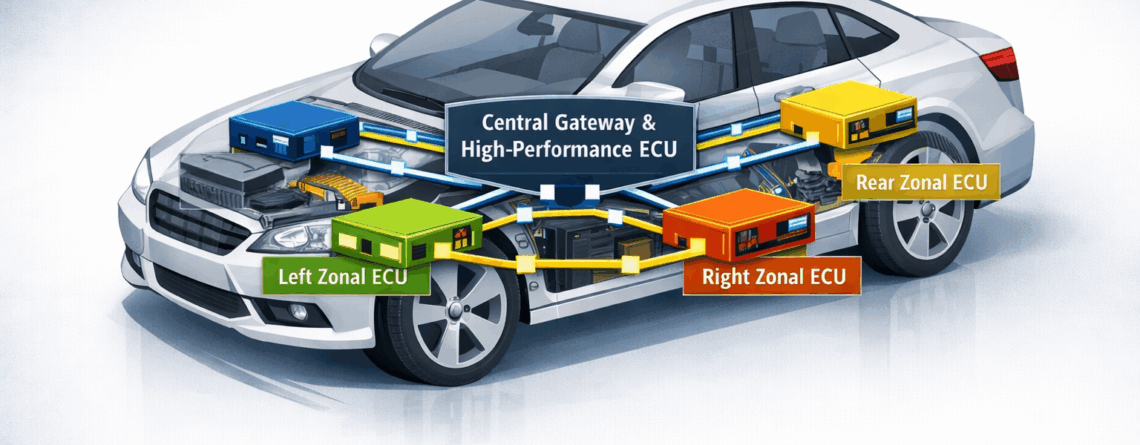
From Domain to Zonal architecture: a new paradigm for in-vehicle communication
Tech Admin2026-04-21T12:09:00+02:00For decades, vehicle architectures have followed a domain-based model.
In this architecture, each functional domain of the vehicle — such as powertrain, infotainment, ADAS, chassis or body — has its own dedicated Electronic Control Unit (ECU). These ECUs manage sensors and actuators distributed throughout the vehicle through complex wiring harnesses. Each of these ECU are independent each-other and typically do not communicate between them.
While effective in the past, this architecture is becoming increasingly difficult to scale.
The limitations of domain-based architectures
As vehicles integrate more electronic functions, the domain-based model introduces several challenges:
- Increasing wiring complexity
- Higher vehicle weight
- More difficult system integration
- Limited scalability for future features
In modern vehicles, wiring harnesses can weigh tens of kilograms, contributing significantly to overall vehicle weight and manufacturing complexity.
The shift toward zonal architectures
To overcome these limitations, the automotive industry is gradually moving toward a zonal architecture.
In this new model, electronic systems are organized according to the physical zones of the vehicle rather than functional domains.
A typical zonal architecture includes:
- A central gateway responsible for system coordination
- One or more central processing units for high-level functions such as infotainment or ADAS
- Multiple zonal ECUs, each managing sensors and actuators within a specific area of the vehicle
All these components are connected through a high-speed Automotive Ethernet backbone.
Key advantages of zonal architectures
Zonal architectures provide several important benefits:
Reduced wiring
Sensors and actuators connect to the nearest zonal ECU instead of routing cables across the entire vehicle.
Lower vehicle weight
The reduction in copper wiring can lead to 20–55 kg weight savings.
Simplified assembly
Shorter and simpler wiring harnesses reduce manufacturing complexity.
Improved scalability
New features can be implemented more easily as the architecture becomes more modular.
Enabling the Software-Defined Vehicle
Zonal architectures are also a key enabler of the Software-Defined Vehicle (SDV).
In this paradigm, hardware platforms become more general-purpose, while functionalities are increasingly implemented through software.
New capabilities can then be introduced or improved through over-the-air (OTA) updates, much like operating system updates on smartphones.
 Flexmedia XM